
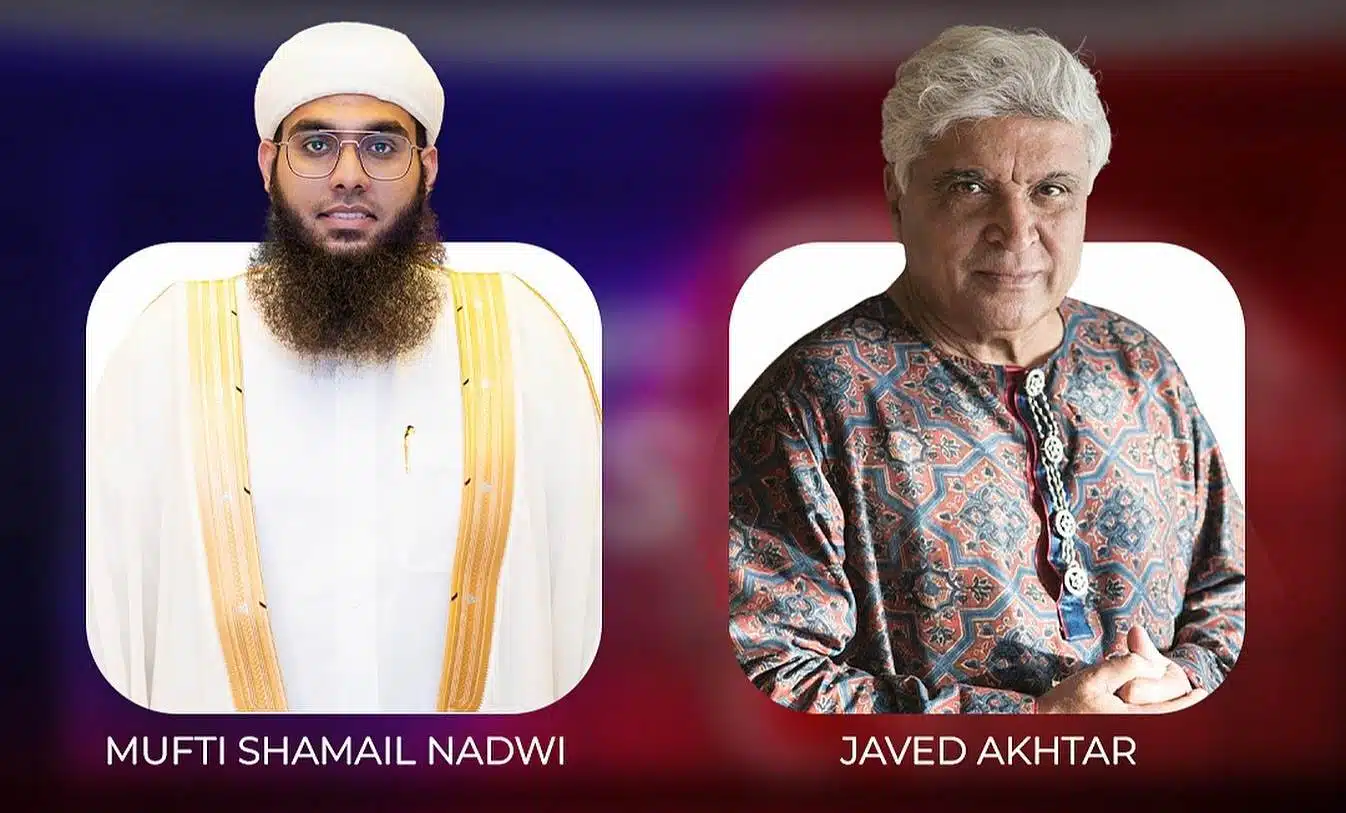
Mufti Shamail Ahmad Abdullah Nadwi, widely known as Mufti Shamail Nadwi, is a young and influential Indian Islamic scholar, educator, preacher, and founder of an online global teaching platform. He has gained widespread attention in India, Pakistan and South Asia through his lectures, online teachings and recent high-profile debate with renowned poet and public thinker Javed Akhtar on the topic “Does God Exist?” in December 2025.
Early Life and Education
Mufti Shamail Nadwi was born and raised in India, where he developed an early interest in Islamic scholarship and religious education. He pursued formal Islamic learning at Darul Uloom Nadwatul Ulama, one of the country’s most respected centres for Islamic studies located in Lucknow.
At Nadwatul Ulama, he completed rigorous studies in Quranic sciences, Hadith, Fiqh (Islamic jurisprudence) and classical Arabic texts, the foundational pillars of traditional Sunni Islamic scholarship. This deep grounding helped shape his scholarly approach and prepared him for guiding students and followers in matters of faith, ethics, and contemporary issues.
In addition to his traditional education, Mufti Shamail continues to broaden his academic horizons. According to some recent reports, he is working on advanced research, possibly a PhD, which positions him uniquely at the intersection of traditional scholarship and modern intellectual engagement.
Founding Markaz Al-Wahyain and Mission
In 2021, Mufti Shamail Nadwi founded Markaz Al-Wahyain, an online Islamic educational institution aimed at providing accessible and structured learning to students across the world, irrespective of geographical boundaries.
Markaz Al-Wahyain offers courses in:
- Quranic interpretation (Tafseer)
- Prophetic traditions (Hadith)
- Islamic jurisprudence (Fiqh)
- Spiritual and ethical guidance
Through this platform, Mufti Shamail has sought to make Islamic learning more interactive, engaging and relevant to today’s youth, especially for students who may not have access to traditional madrasas or scholars.
Alongside the educational institute, he is associated with the Wahyain Foundation, a charitable and religious trust that works to promote Islamic values, community welfare and support for underprivileged families.
Presence on Social Media and Digital Outreach
One of the key reasons Mufti Shamail Nadwi has become a trending figure among Indian and Pakistani audiences is his dynamic online presence. He is active on platforms like:
- YouTube
- X (formerly Twitter)
- Telegram and WhatsApp groups
His YouTube channel features lectures, live question-and-answer sessions, and discussions on theology, daily life and contemporary issues facing Muslims and youth.
Many of his videos have garnered tens of thousands of views, and some, especially discussions related to modern challenges, faith questions and theological debates, have gone viral. He uses simple language to answer complex religious questions, making him especially popular with young audiences in India, Pakistan and the wider Muslim community.
Breakthrough: Debate With Javed Akhtar (2025)
Mufti Shamail Nadwi became a national and international talking point in December 2025 when he participated in a widely watched debate with Javed Akhtar, the famous Indian poet, lyricist and self-declared atheist.
The event, titled “Does God Exist?”, took place in New Delhi’s Constitution Club and was moderated by journalist Saurabh Dwivedi from The Lallantop. The debate was streamed live and attracted millions of views online within hours of beginning, becoming a viral topic on social media across both India and Pakistan. (The Indian Express)
During the nearly two-hour debate, both speakers addressed one of humanity’s oldest and most profound questions using logic, philosophy, ethical concerns and personal belief systems. Mufti Shamail Nadwi argued from a faith-based perspective, emphasizing that belief in God transcends physical evidence and that science and reason alone cannot explain the metaphysical nature of creation. (Deccan Chronicle)
He highlighted that human suffering or moral contradictions are the result of human free will rather than divine neglect, a point that sparked intense discussion and reactions online.
The debate also drew attention because it bridged intellectual, cultural and religious divides, inviting audiences of different beliefs and philosophies to engage in civil discourse about faith, reason and modern life.

Style, Influence and Public Perception
Mufti Shamail Nadwi’s style blends classical Islamic thought with modern communication techniques, enabling him to appear both scholarly and accessible. His calm demeanor, clear articulation and willingness to engage in public dialogue distinguish him from more traditional scholars who rarely participate in televised debates.
While his arguments have received praise from supporters for their clarity and depth, critics — including some secular commentators, have questioned his logical framing and philosophical positions. Online forums have been buzzing with varying interpretations of his debate performance and theological positions, reflecting a wide spectrum of public response.
Legacy, Impact and Future Outlook
Although still early in his scholarly career, Mufti Shamail Nadwi has already carved out a significant presence in the Islamic intellectual landscape of South Asia. His contributions include:
- Bringing classical scholarship to digital platforms
- Engaging diverse audiences on contemporary challenges
- Fostering religious dialogue in a pluralistic world
As he continues his academic and public work, including advanced research, publishing and community outreach, Mufti Shamail is expected to remain a key voice for young Muslims seeking answers that connect tradition with modernity.
Conclusion
Mufti Shamail Nadwi’s journey from a dedicated student at Darul Uloom Nadwatul Ulama to a globally recognized Islamic educator and public speaker shows how tradition and technology can intersect to shape meaningful influence. His recent high-profile debate on the existence of God has not only increased his visibility but also sparked deeper interest in theological and philosophical discussions throughout India, Pakistan and beyond.


